Welcome to the secret within us…
Now available!






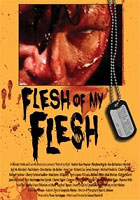 High concept and low budget intersect in Flesh of my Flesh, a gory zombie romp filled with bullets, betrayal, and bloodshed — and that’s before the zombies get involved!
Flesh of my Flesh chronicles mankind’s final hours in the last great war for existence. A secret hides within our society, within our bodies, our cells, our very DNA. At times, this secret reveals itself — the past, ancient times, prehistory — and those are days of hunger and terror. There are whispers of those times, stories told by descendants of the survivors, but they’re only fragments of the truth — only what we can hear without going mad out of self-preservation. We cannot handle the naked truth. With our machines and medicine and psychology, we think we’ve mastered the terrified monkey within, but when that thin shell of self-deceit tears away, when we face the truth, it shatters our mind. It always has. It always will.
An embedded research team reveals themselves to rescue their own beleaguered rescue party. This triggers a snowball of betrayal, jealousy, love, and redemption, punctuated by bullets, pain, and death. After the bullets, pain, and death come more revelations.




Trailer
Cast
- Nurse: Katrina Martin (IMDb listing)
- Mike: Chase Fulton (IMDb listing)
- Grampa: Brian Jones (IMDb listing)
- Victoria: Liberty HarbourSwallow (IMDb listing)
- Lori: Susan Spencer (IMDb listing)
- Doctor Levinsky: Jodi M. Altendorf (IMDb listing)
- Mark Love: Bill Kelley (IMDb listing)
- Major Erick Vaas: Matthew Martin (IMDb listing)
- Corporal Francis Adkins: Shannon Wills (IMDb listing)
- Messenger: Charles Prince
- Bruce Ayala: Rex Irae
- Katherine Ayala: Heather Rose Pearson
- Herbert West: Ron Richardson
- Lindsey Corrigan: Tara Walker (IMDb listing)
- Tom Reese: Gil Luna (IMDb listing)
- Jeff Knapp: Tom Moorman
- Iron John: Drew Barrios (IMDb listing)
- Lieutenant Zombie: Paul Watts
- Farm Boy Zombie: Jaime McFarland
- Fred: Mad Martian (IMDb listing)
- Scared Zombie: Richard Cox
- Gate Guard: Michael Friedrichs (IMDb listing)
- Private Carr: Anne Carr
- Private Becker: Jim Becker (IMDb listing)
- Private Kirk: Kevin M. Kirk
- Private Osinski: Alex Osinski (IMDb listing)
- Colonel Davies: Richard Mann
- Radioman: Michael Harbour
- Reluctant Pilot: Nature
- Hospital Patients: James Deswart, Terry Lopata (IMDb listing)
- Soldiers: Paul Asbury, Cameron Rhyne (IMDb listing), Alex Osinski
- Medical Examiner: Sue Pethick
- Human Victims: Nolon Ashley, Aurora, Autumn, Buddha, Jesse Camac, Jen Go, Anna Green, Michael Harbour, Patrick Kwan, Jeanne Mitchell, Alexandra Paris, Jaine Powers, Charisse Rene, Cameron Rhyne (IMDb listing), Toby Wickwire
- Zombie Horde: Heather Abbott, Barclay Albright (IMDB listing), Reza Aleaziz, Jodi M. Altendorf (IMDb listing), Lorraine Bacuita, Terence Bacuita, Amanda Bailey, Andrew Baker, Damian Banki, Christine Becker, Gabriele Benedict, Greg Bigoni, Brian Bishop, Stephen Bolton, Julie Bond, Sven Bonnichsen, Gabby Brooks, Keagan Brooks, Rhoda Brooks, Doug Brumby, James W. Burgen Jr., Charles H. Carr, Barry Coghill, James B. Comstock, Kees Cook, April Danger Cox, Jonah Danger, Autumn Dawley, Lily Delaney, Chris Dorr, Tim Dufala, Jacob Dunn, Brenna Dykman, Miriam Elman, Debra Erickson, Joslyn Erickson, Alex T. Evans, George Evans, George M. Evans, Lois M. Feuerle, Sandy Finch, Patrick Fitzgibbons, Kristen Flora, Casey Ford-Webb, Scott Freshner, Robert Frisbee, David Frostad, Heather Garcia, Andrew Garrettson (IMDb listing), Shawn Garrison, Victoria Geyer, Matthew A. Gibbs, Marina Giorgi, Jennifer Go, Nick Gradt, Kurt Granzow, Mary E. Grimshaw, Kevin S. Grisell, Damian Gudino, Tarika Hananait, Jeremy Hansen, Jonny Harbin, Michael Harbour (IMDb listing), Liberty HarbourSwallow, Karyn “Cal” Harmon, Sarah Hayes, Brendt W. Hess, Laurel S. Hess, Scott Hibbetts, Maryjane Hoadley, Nate Hoffen, Brad Holden, Joseph Hundley, Elizabeth Hunt, James Hunt, Katherine Hunt, Aaron D. Huntington, Rebecca Huntington, Travis Huntington (IMDb listing), Jamie M. Hutchinson, Phillip Hutton, Eri Ichimura, Brenda Jeffers, Katherine Jenkins, Laura Jenkins, Jeffrey F. Jenkins Jr., Cassandra Johnston, Steven T. Kaminsky, Garth W. Kaufman, Todd Kelley, Kris Krattiger, Gretchin Lair, Rich Landar, Daria Landar, Harry Lane, Nik Lane, Teresa Lane, John Lawson, Amber Lea (IMDb listing), Barbara Leese, Jonathan Lett, Clyde Lewis, Kristin “Muffin” Lieser, Roslyn G. Lindquist, Daniel Linn, Lilian Lust, Alice Luxton, Josh Lynch, Julie Macalister, Kate Macdonald, Michael Mager, Andy Mangels (IMDb listing), Jonathan Manley, Sylvia L. Mann, Leopoldo Mariño (IMDb listing), Tara Mariño, Sarah L. Covert, E. C. Mathews (IMDb listing), Angi McFarland, Jaime McFarland, Tim McGaff, Shawn McKay, Ashley Mercado, Stephen Mesa, Andrew Migliore (IMDb listing), Paul Miller, Angie Mohagen, Alison Brooke Monfort, Christine Moore, Holly Morgan, Tristan Mudd, Melody Murphy, Adriane Myers, Karli Nabours-Palermo, Alex M. Neal, Amy Neitzel, Harriet Nixon, Lisa Ommert, Danny Oxman, Emily Palmer, Sarah Palmer, Alexandra Paris, Al Partridge, Christene E. Peabody, Michael Pearce (IMDb listing), Chris “Chrispy” Perisho, Christian Platt (IMDb listing), Barbara Polizzi, Katherine Poor, Frank H. Prevatt, Jr., Charles C. Prince, Patricio Ramirez, Joelle Rash, Cameron Rhyne, Brian Rice, Catherine E. Ridenour, Dean Rodgers, Marcos Rosero, Alex Santos, Rocky Savage, Steven Sellers, Shaiyel Seltzer, Wendy Showell, Melody Singman, Liv Rainey-Smith (IMDb listing), Michael C. Smith (IMDb listing), Aaron D. Smith, Sohei, Susan Spencer (IMDb listing), Dustin Stallings, Ed Stastny, Jennifer Stein, Helen-Ruth Stephens, Greg Stoker (IMDb listing), Kelsey Stokes, Dwight Stone (IMDb listing), Glenn Storm, Sean Strauss (IMDb listing), Kirk Stubblefield, Brandt Sundholm, Nicole Swearingen, Mitch Talbot, Stacie Thering, Rebecca Thompson, Brett A. Tramposh, Saxon Umberger, Tasha Underhill, Lorne Vaught, Mark Vetanen (IMDb listing), Doug Walters (IMDb listing), Briana Weber, Natalie Weintraub, Paul F. Weir III, Rusty Weise, David West, Teresa White, Jason A. White, Toby Wickwire, Lorin Wilkerson, Teddy L. Wilson Jr., Gary Wolfe, Alisa C. Wood-Walters (IMDb listing), Nicholas Yardley, Kristin Yount, Kyle Yount, Donald Zeck
Crew
- Written & Directed: Edward Martin III (IMDb listing)
- Director of Photography: Ryan K. Johnson (IMDb listing)
- Producer: Travis Huntington (IMDb listing)
- Production Designer: Justin Hugh O’Shaughnessy (IMDb listing)
- Art Director: Samuel Lamport (IMDb listing)
- Production Manager: Travis Huntington (IMDb listing)
- Assistant Director: Leopoldo Mariño (IMDb listing)
- Editor: Sean Strauss (IMDb listing)
- Second Assistant Director: Sarah L. Covert
- Post Production Supervisor: Katrina L. Martin (IMDb listing)
- Sound Design: Cyoakha Grace O’Manion (IMDb listing) and Eric Nielsen
- Sound Engineer: Eric Nielsen
- Boom Operators: James Deswart, Sean Strauss (IMDb listing)
- Gaffers: Will Brown (IMDb listing), Brett Tramposh
- Grips: Ryan K. Johnson (IMDb listing), Sean Strauss (IMDb listing), Brett Tramposh, Mark Vetanen (IMDb listing)
- Prop Master: Terry “Propmaster T” Lopata (IMDb listing)
- Props: Amber Bariaktari, James Deswart, Rick Heinichin, Paul Hunt, Garth W. Kaufman, Michelle Krause, Katherine Macdonald, Leopoldo Mariño (IMDb listing), Jaime McFarland, Steven Poor, Sean Strauss (IMDb listing), Mitch Talbot, Nicole VanDerHeyden (IMDb listing), Carmen Walker (IMDb listing), Doug Walters (IMDb listing), Steve Woodward
- Sound Effects Assistant: Leumis Richardson
- Special Effects Artists: Teri K. Clark, Kees Cook, Ross Dalton, Robin Edwards, Ken Fisk, Daniel Johnson, Thomas D. Luth, Jennifer L. Panter, Randy Sanders (Atomic Perception), Kirk Stubblefield, Andy Tubbesing, Denise K. Wynn
- 3D Animator: Aaron Meziere
- Set Dressing: Barclay Albright (IMDB listing), Michelle Krause, Greg Stoker (IMDb listing), Carmen Walker (IMDb listing)
- Second Camera Operators: Sean Strauss (IMDb listing), Mark Vetanen (IMDb listing)
- Clapper/Loader: Mark Vetanen (IMDb listing)
- Production Assistants: Erik Chevalier (IMDb listing), April Danger Cox, Amber Bariaktari, Paul Hunt, Jonathan Locke, Tim McGaff, Sean Strauss (IMDb listing), Doug Walters (IMDb listing), Briana Weber
- Location Coordinator: Sean Strauss (IMDb listing)
- Location Assistance: Joslyn Erickson, Greensoda Productions, Travis Huntington (IMDb listing), Richard Mann
- Makeup Lead: Amber Lea (IMDb listing)
- Makeup: Geahk Burchill, Brenna Dykmain, Joslyn Erickson, Karyn “Cal” Harmon, Paul Hunt, Carrie Jensen, Michelle Krause, Shashonna Knecht, E. C. Mathews (IMDb listing), Liv Rainey-Smith (IMDb listing), Antoinette Saletta, Crystal Shade (IMDb listing), Jennifer Stein, Nicole Swearingen, Briana Weber
- Hair: E. C. Mathews (IMDb listing), Nicole Swearingen
- Armorer: Alex Osinski
- Fight Choreographers: Roslyn Lindquist & Kami Miller, Ron Richardson, Susan Spencer (IMDb listing)
- Gun Wrangler: Robert Frisbee, Steve Poor
- Production Construction: Geahk Burchill, Matthew Gibbs, Jason Henry, Michelle Krause, Samuel Lamport (IMDb listing), Terry “Propmaster T” Lopata (IMDb listing), Jaybird Marmaduke, Sarah L. Covert, Jaime McFarland, Greg Stoker (IMDb listing), Carmen Walker (IMDb listing)
- Electrical Props: Barclay Albright (IMDB listing), Matthew Gibbs, Leopoldo Mariño (IMDb listing), Greg Stoker (IMDb listing), Sean Strauss (IMDb listing), Brett Tramposh, Mark Vetanen (IMDb listing)
- Electrician: Tim McAvoy
- Puppet/Armature Construction: Michelle Krause, Amber Lea (IMDb listing), Terry “Propmaster T” Lopata, Jason Ropp, Nicole Swearingen
- Puppeteering: Amber Lea (IMDb listing), Leopoldo Mariño (IMDb listing), Mad Martian (IMDb listing)
- Model Builder: Elizabeth West
- Matte Painting: Michelle Krause, Jaybird Marmaduke, Joseph William White, CC
- Molding: Erik Chevalier (IMDb listing)
- Researchers: Lisa Box, Katrina L. Martin (IMDb listing)
- Script Supervisor: Richard Mann
- Wardrobe Supervisor: Gil Luna
- Wardrobe Assistance: Joslyn Erickson, Elsbeth Knott, Enrika Newbury (IMDb listing), Liv Rainey-Smith (IMDb listing)
- Set Photographers: Gil Luna, Paul Miller, Roger Povda, Mark Vetanen (IMDb listing)
- Set Security: Barclay Albright (IMDB listing), Karyn “Cal” Harmon, Tim McGaff, Frank H. Prevatt, Jr., Mikel Thurman
- Craft Services: Susan Byron, Karyn “Cal” Harmon, Katherine Macdonald, Katrina Martin (IMDb listing), Angi McFarland, Dwight Stone (IMDb listing), Nicole Swearingen, Doug Walters (IMDb listing), Alisa C. Wood-Walters (IMDb listing), Kate Webb (IMDb listing), Jamie Wilcox
- Systems Administration: Christopher Martinsen (IMDb listing)
- Documentarian: Sean Strauss (IMDb listing)
- Logo Design: Leslie Harker
- Set Witch: Rowan Ashe
- Zombie Jewelry: Liv Rainey-Smith (IMDb listing)
- Special thanks to: Alan Kinsley
- Special thanks to: Charles M. Neal
- Special thanks to: Cheapass Games
- Special thanks to: Costa-Pacific Properties
- Special thanks to: Dan Powell
- Special thanks to: Deno’s Pizzeria
- Special thanks to: Derek M. Koch
- Special thanks to: Derek Vanderzanden
- Special thanks to: East2West Studios
- Special thanks to: Evergreen Helicopters, Inc.
- Special thanks to:Frank and Cindy Harris
- Special thanks to: Grayson J. Barrows
- Special thanks to: Greg Gentry
- Special thanks to: Guy Matthews
- Special thanks to: Jayne Menard
- Special thanks to: Henry Miller
- Special thanks to: Incubator Studios
- Special thanks to: Jack Deswart
- Special thanks to: Karen Thomas
- Special thanks to: Longbottom Coffee
- Special thanks to: Lorne Vaught
- Special thanks to: Mark Landers
- Special thanks to: Massage Envy
- Special thanks to: Matt Roloff
- Special thanks to: Material Flow & Conveyor Systems, Inc.
- Special thanks to: Media Blitz Productions, Inc.
- Special thanks to: Media F/X
- Special thanks to: Ocean Spray Motel
- Special thanks to: Pacific Paper Trading Company
- Special thanks to: Lenny Parrot
- Special thanks to: Poorman-Douglas
- Special thanks to: Rainy Day Games
- Special thanks to: Rudie Wilhelm Warehouse Company
- Special thanks to: Scream at the Beach
- Special thanks to: Sweet Delights Fine Candies
- Special thanks to: Tillamook County Fairgrounds
- Special thanks to: Unicru
Music Credits
- Music Supervisor/Composer: Cyoakha Grace O’Manion (IMDb listing)
- Music Credits Music Composers: Cyoakha Grace O’Manion (IMDb listing) & Mark “Equinox” Brown
- Sound Weaving: Cyoakha Grace O’Manion (IMDb listing)
- Opening Hallway CreditsZombie Drums: Claudia Paige
- “Blood Dripping Song”: Druid Sisters Tea Party
- Drums: Claudia Paige
- Electric Guitar: Tricia Godwin
- Vocals: Cyoakha Grace O’Manion (IMDb listing)
- Electric guitar & Scream: Leo Taglialavore
- All military scenes Drums: Claudia Paige
- Katherine’s Theme M. Brown
- Bruce’s Theme M. Brown & Cyoakha Grace O’Manion (IMDb listing)
- Doctor West’s Theme Cyoakha Grace O’Manion (IMDb listing)
- Explosion SceneGlass by Azigza, from the CD Azigza
- State of Grace & Tamboura LoungeCyoakha & Land of the Blind, from the CD Shamans of Sound
- Field Recordings/Big CatsKrystov & Cyoakha Grace O’Manion (IMDb listing)
- March of the Dead, Etu Frappe Redeaux, A light in the Fog, Ice Caves, Ether VenturesMark “Equinox” Brown, from the CD Driven by the Flesh, Worlds Beyond Language
- This is My World, Beast of Belief, Eating Memories, Dark Moon, Zombie Beds, Toy Opera Cyoakha Grace O’Manion (IMDb listing)
- All other works are a collaboration between composers Cyoakha Grace O’Manion (IMDb listing) & Mark “Equinox” Brown, on Dreamtime Soundscapes & PORTAL
- Come visit cyoakhagrace.com
- landoftheblind.com
- druidsisters.com
- claudiathedrummer.com
- facebook.com/landoftheblind
- facebook.com/worldsbeyondlanguage